
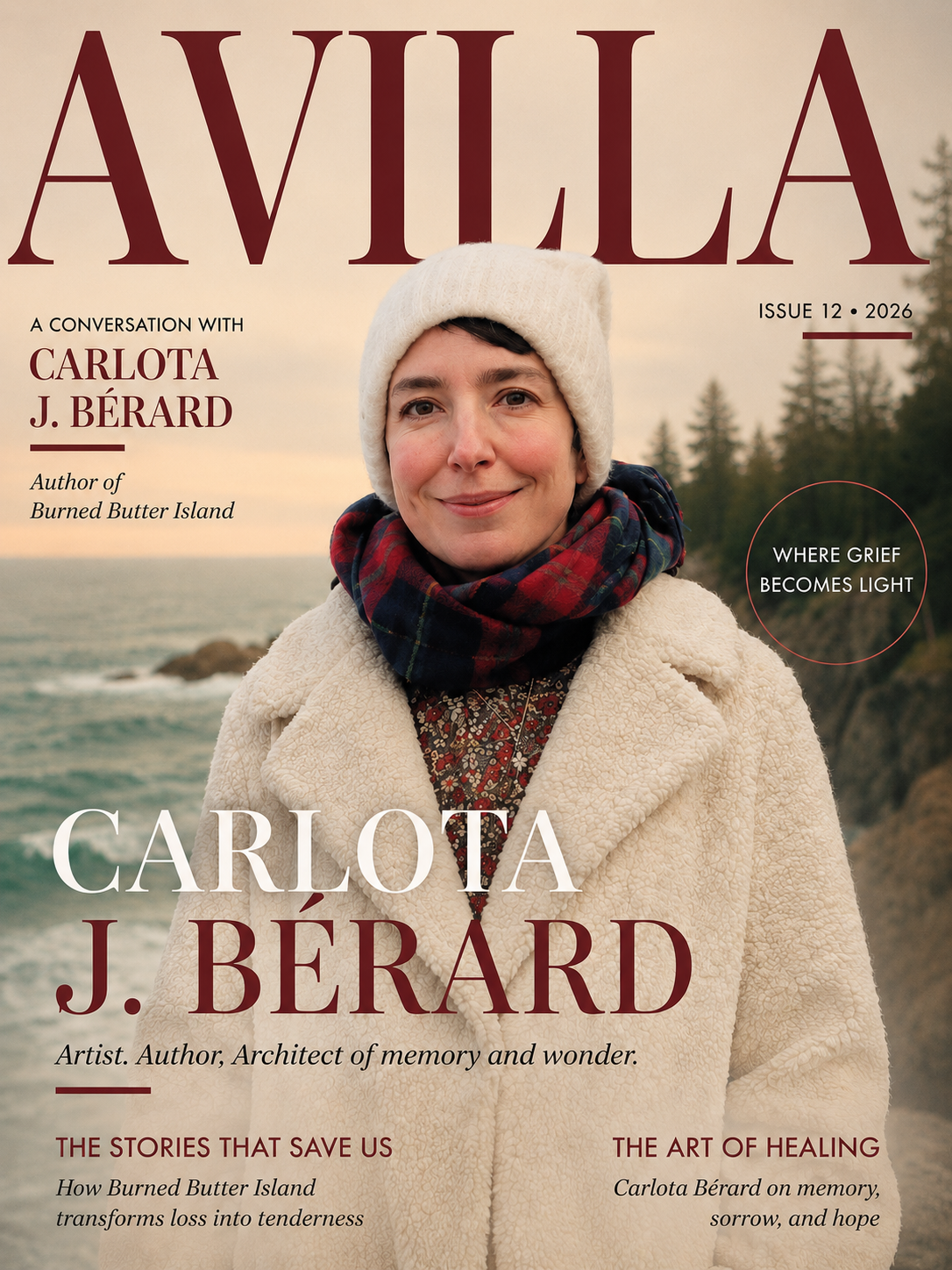
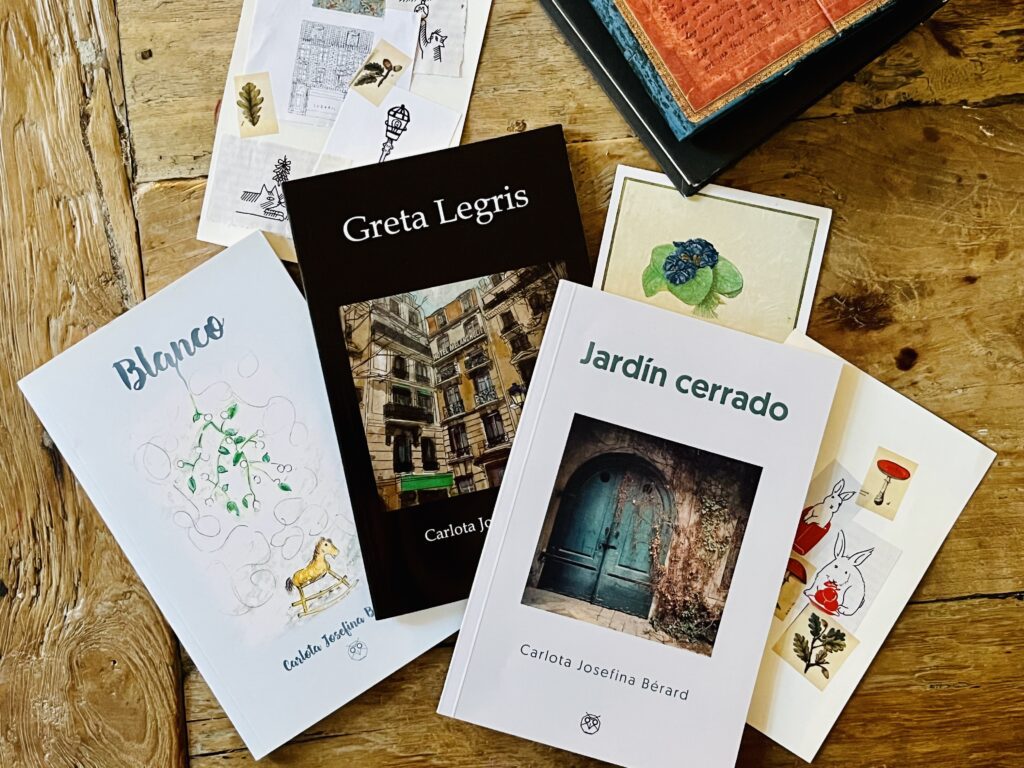
Carlota Josefina Bérard is a Mexican-born artist, poet, and novelist currently based in Austria. The author of several books, including Greta Legris, Blanco, Jardín Cerrado, and the poetry collection The Blue Whale Sings from Afar, Bérard brings together visual artistry, poetic sensibility, and storytelling in works that explore beauty, grief, spirituality, love, and wonder. Her latest book, Burned Butter Island, is a lyrical and enchanting tale of childhood loss, healing, magic, and the transformative power of love.
Can you introduce yourself to our readers and tell us a little about your journey from Mexico to Austria as a writer and artist?
I was born in Mexico many years ago. I graduated with a Bachelor degree of Fine Arts and left when was twenty-one to the Old Continent. I lived in different cities within Europe where I studied a Master in Art History, Art Therapy and a Doctorate in Contemporary Art. I live in Vienna with my husband, son and our dog.
You describe yourself as an artist, poet, and novelist. How have these different creative identities influenced and enriched one another in your work?
They complement each other one way or another. All are imageries and feelings expressed with different mediums: letters, colors and shapes.
You have published several books, including Greta Legris, Blanco, Jardín Cerrado, and The Blue Whale Sings from Afar. How would you describe your literary evolution across these projects?
My three works in Spanish are short novels in poetic prose, then I switched to English, for I felt what I needed to say I could express it better in English. I find English simpler than Spanish, as a language, yet as beautiful! I love simplicity! And particularly, I love poetry in English.
How many books have you written so far, and do you see your books as part of a connected creative vision or as entirely distinct literary worlds?
Five books and they are all connected; the stories and characters including their words reflect my life. It is a form of autobiography or a diary of self-reflection, although at some moments fiction is intertwined and a lot of poetry. It is my heart, my most intimate that lie within the pages.
What first inspired Burned Butter Island? Did the story begin with the island setting, the grieving child, or the magical symbolism of the narwhal?
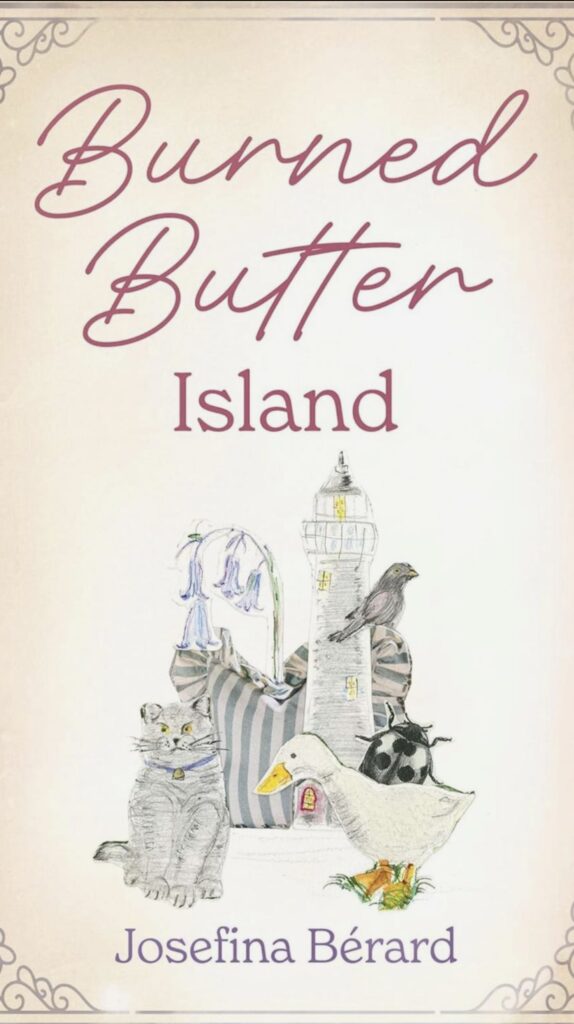
The story began with grief and with the illustrations. I was in a period of grief due to my mama’s death and the loneliness of my father; painting was therapeutic for me, unconsciously the illustrations of Burned Butter Island appeared first and then later, informed and inspired me to write the story.
Burned Butter Island has a timeless fairy-tale quality, blending maritime adventure, grief, and magical realism. Which authors, books, or traditions most influenced the tone and atmosphere of this novel?
The Danish Hans Christian Andersen and his fairy tales and the English Lewis Carroll author of Alice in Wonderland; these authors and his writings have a profound influence in my work.
The imagery in the book is striking—lighthouses, storms, forests, blackberry tarts, gramophones, maps, and rocking horses all contribute to a dreamlike world. Why were these details important to you?
They are objects, images, places, which are beautiful, that I feel stop time, somehow, or they enable us to savour it profoundly, more joyfully and wholeheartedly.
At its heart, the novel explores a child grieving the loss of his mother. What drew you to writing about loss and healing through a child’s emotional perspective?
The death of my mother; writing this book healed me, helped me with my process of grief. My child also asked me, at this period of my life, to write him a fairytale and to illustrate it; so I wrote Burned Butter Island as gift to him.
The narwhal and its tusk serve as powerful mystical elements in the story. What does the narwhal symbolize for you personally and within the book?
I love them, for they are rare, timid, ancient creatures, they love deep, cold water, and are also called unicorns of the sea. They symbolize intuition, magic, your inner truth, strength, emotional intelligence, the power to heal your heart, your emotions; all these elements are within Burned Butter Island.
Animals play deeply symbolic and emotional roles in the novel, from Bell the cat and Snow the duck to the white deer and narwhal. Why are animals so central to your storytelling?
Animals are beautiful, I love them. Throughout the centuries animals and nature (also beautiful) play a significant role in storytelling, fables and fairytales… we are all within this world together; we should respect and care for each other.
Your prose often reads like poetry, with lyrical passages woven into the narrative. How do you approach balancing poetic language with storytelling?
It comes unconsciously; I like telling stories and that they have a musicality, rhyme and beauty within them.
Do your stories begin as prose and become poetic through revision, or does the poetic rhythm emerge naturally from your first draft?
The poetic emerges naturally, instantly.
As both the writer and illustrator of this book, how does your visual artistry shape your writing process?
For Burned Butter Island the paintings came first, then came the fairy tale before writing it. At the end, the images I painted, were cut and glued with other ones to create collages that are the final illustrations.
You designed both the cover and interior illustrations for Burned Butter Island. How important is visual storytelling in your creative vision as an author?
Everything; visual storytelling emerges from your heart and your mind through images, then a story is born.
What does your creative process look like when working on a new book? Do you follow a structured writing routine or work more intuitively?
Intuitively.
Themes of sadness, love, hope, memory, and healing are woven throughout the novel. What emotional or philosophical experience do you hope readers take away from the book?
That after the loss of someone we love deeply, life still goes on, that it is worth it to live it fully and happily, that there is hope, that there is life after death, that there is faith, that there is LOVE.
Your writing is rich with sensory beauty: flowers, candles, sea salt, lavender, velvet ribbons, baked desserts, and seasonal imagery. Why are beauty and texture such important aspects of your literary style?
I believe in the poetry of little things. I believe in little details that we sometimes forget to see or feel and that are full of beauty; they can make us truly happy and help us live our lives in a more loving way. There is poetry in everyday living, if we are open to it, to see it and feel it.
There are spiritual undertones in the novel, including ideas of heaven, divine love, and transcendence. In what ways does spirituality influence your writing?
It imbues my writing. I have faith in life after death. I believe in God; I believe in Jesus, in Mary, the angels and saints. I am Catholic. “God is love,” St. John, says in the Bible. And LOVE is ALL! If we, human beings, would truly love, the world would be different.
What advice would you offer aspiring writers hoping to create literary fairy tales, poetic fiction, or emotionally resonant stories for readers of all ages?
Follow your heart!
Where can readers purchase your books in both English and Spanish, and which of your books would you recommend new readers begin with?
All my books can be purchased at Amazon and Barnes & Noble; they can start with any book they feel like and follow their heart.