
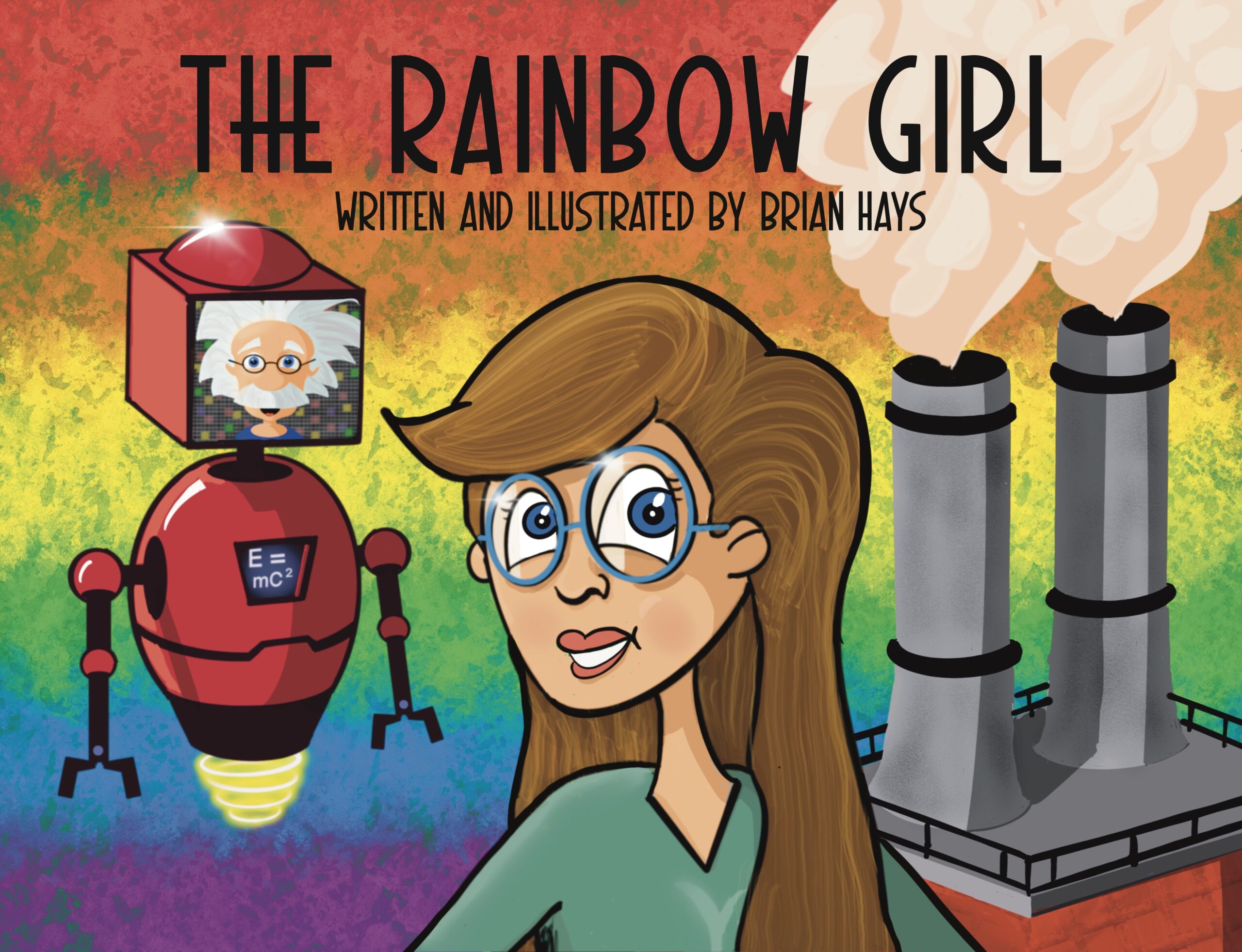
The Rainbow Girl
by Brian Hays
Characterization, Craft, and What It Offers Children Growing Up Today
Overview
The Rainbow Girl follows Olivia Thompson across a decade of her life, from a school science-fair project to a teenage breakthrough that earns her global recognition. She begins by building Breakfast Bot, a kitchen robot assembled from household parts, escalates to Dusty Jokesabot, a walking, wisecracking companion built from welded aluminum and steel, and culminates in Albot, an artificial intelligence modeled on the mind of Albert Einstein, with whom she engineers the Clean Air Pod, a device that scrubs greenhouse gases from the atmosphere and, as a side effect, fills the sky with rainbows. The press christens her the Rainbow Girl, and the book closes on that title.
It is, structurally, a coming-of-age invention story disguised as a picture book, and it is worth reviewing on those terms: not only as a pleasant story, but as a text that will sit in a child’s hands at a specific cultural moment, when climate anxiety and artificial intelligence are no longer background concepts but daily realities for young readers.
Characterization
Olivia
Olivia is the book’s clear strength. She is written as competent rather than gifted, someone who accumulates the specific tools of her inventions through named, ordinary channels, an electronics class, a shop class, independent research on global warming, rather than through unexplained brilliance. This is a meaningfully different model of the child hero than the usual prodigy narrative, and it is the book’s most valuable authorial choice. The cost of this choice, however, is that Olivia remains almost entirely external. We see what she builds and, briefly, what she decides, but we rarely see what she feels. Her excitement is reported (“Olivia is so excited!”) rather than dramatized, and the one moment where an interior life might matter most, the instant her invention succeeds on a planetary scale, is handed to a news broadcast instead of to her. A reader spends ten years with Olivia and never quite learns who she is when no one is watching her build something.
Albot
Albot, the Einstein-modeled AI, is a clever narrative device more than a character. Giving Olivia a research partner allows the book to tackle an adult-scaled problem, global warming, without asking a teenager to solve it through unaided genius, which is a real craft solution to a common failure point in kid-inventor stories. But Albot is thin as a presence: a German accent and a talent for physics are the entirety of his characterization, and he disappears from the story’s emotional register almost as soon as he has served his structural purpose. He is a plot function wearing a personality, not yet a fully-imagined collaborator.
Dusty Jokesabot and the Supporting World
Dusty Jokesabot suffers the same fate more severely: he exists for a joke sequence and is never mentioned again once that sequence ends, an orphaned character rather than a retired one. More broadly, the human world around Olivia, parents, teachers, friends, is almost entirely absent. She appears to build two of her three major inventions in total social isolation, which flattens the story into a solitary-genius arc even as the narration insists she “can’t tackle this problem on her own.” The book gestures toward collaboration as its stated value but rarely stages it on the page.
Strengths
- A process-driven model of achievement. Olivia’s competence is shown as the product of specific, named skills acquired over time, not innate talent, which is a rare and valuable message for a children’s STEM narrative.
- A well-built escalation. Breakfast Bot to Dusty Jokesabot to Albot to the Clean Air Pod forms a clean staircase of rising ambition, each invention plausibly outgrowing the skills established just before it.
- A girl inventor who solves a planetary problem without being asked to do it alone. Pairing Olivia with an AI collaborator, rather than making her a lone-genius savior, is a structurally sound way to let a child protagonist take on climate change at scale.
- Genuine STEM texture. Circuit boards, soldering, welding, programming logic, and a labeled machine diagram all appear as real, learnable processes rather than magic, at least until the story’s final invention shifts registers (see below).
Weaknesses
- Tonal whiplash. A full page of stacked one-liner jokes sits immediately beside a dense, textbook-style explanation of the greenhouse effect. The two registers, slapstick and science primer, do not speak to each other, and the effect reads as two manuscripts stitched together rather than one authorial voice modulating in tone.
- An unsignaled leap from invention to science fantasy. The first two robots are grounded in real, if simplified, engineering. The Clean Air Pod, a serum that converts carbon dioxide into oxygen, delivered by a device that also happens to run on an antigravity accelerator, asks for a much larger suspension of disbelief without acknowledging the shift, which risks undercutting the credibility the earlier, more grounded sections worked to build.
- An externalized ending. The story’s climax is delivered as a news headline rather than a scene experienced with Olivia, denying the reader the one moment that most needed her point of view.
Takeaway for Kids
Underneath its plot, the book is teaching a child reader a set of quiet lessons, and most of them are good ones. It says that expertise is built, one class and one failed prototype at a time, not granted. It says that big problems are legitimately too big for one person, and that asking for help, even from a machine, is a form of strength rather than a concession. It says that curiosity is allowed to wander, from breakfast to jokes to climate science, without needing to justify itself in advance.
What it does not yet teach, and what a revision could add, is that competence coexists with doubt. Olivia never fails in a way that costs her anything, never hesitates, never appears frightened by the size of the problem she has taken on. For a book aimed at children who will themselves inherit the greenhouse effect described so carefully in its middle pages, a beat of Olivia’s own uncertainty, and her decision to keep going anyway, would be a more honest and more usable model than her uninterrupted success.
Relevance to Children’s Lives Today
This book is arriving in front of children who are growing up inside two conditions this story speaks directly to: pervasive, developmentally significant climate anxiety, and an early, largely unsupervised relationship with artificial intelligence. Both give the book a relevance it may not have been consciously written for, and both are reasons to take its choices seriously rather than treat it as a light diversion.
On climate, researchers have increasingly documented that children and adolescents report high levels of worry and a sense of powerlessness about environmental futures they did not create. A story in which a young person’s specific, learnable skills lead to a real reduction in atmospheric harm is a meaningful counter-narrative to that helplessness, so long as it does not imply that one clever teenager, or one clever machine, closes the case. The manuscript does include a brief, honest hedge, “this will not solve global warming, as there are certainly other contributing factors”, but it arrives late and is easy to miss. Moved earlier and given more weight, that single sentence could do real work: it would let a young reader take genuine hope from Olivia’s agency without absorbing the less useful idea that individual invention, rather than collective and political effort, is what solves a planetary problem.
On artificial intelligence, Albot represents an unusually gentle entry point for children who are already encountering AI systems, chatbots, tutors, voice assistants, in their daily lives well before they have the conceptual tools to think critically about them. Portraying an AI collaborator as warm, quirky, and genuinely useful, rather than as either a servant or a threat, models a healthier frame than much of the surrounding cultural conversation currently offers a child. That said, the book never shows Olivia questioning Albot, correcting him, or grappling with any limitation in his thinking, which is a missed opportunity: a child audience would benefit as much from seeing a character use AI critically as from seeing her use it successfully.
Finally, the closing image, a teenager renamed by the press for a single act of public good, mirrors a very real contemporary pattern in how the culture at large elevates young climate figures. That familiarity is part of what will make the ending resonate with kids and the adults reading alongside them. But because the book gives that recognition to Olivia rather than letting her recognize herself first, it slightly reinforces the idea that a child’s achievement becomes real only once the world names it, rather than once she has named it for herself. A short scene of Olivia’s private reaction, placed before the broadcast rather than instead of it, would let the book keep its satisfying public ending while also handing the child reader the interior model they are more likely to actually use.
A Note on Illustration and Pacing
The accompanying trailer storyboard, built from the book’s own art, unintentionally confirms one of this review’s structural concerns. Its emotional peak, the moment the Clean Air Pod produces its first rainbow, is the single image the storyboard could not source from the uploaded material, and a placeholder of assembly robots stands in for it instead. That the book’s visual climax is also its hardest image to lay hands on is a small but telling sign that the rainbow payoff, thematically the whole point of the title, is under-illustrated relative to its importance. A future printing or trailer cut would benefit from making sure this exact image, Olivia and Albot witnessing the rainbow for the first time, gets a full, unhurried page of its own, ideally with her face visible and reacting, since this is precisely the private beat of recognition the narrative currently skips past on the way to the news broadcast.
It is also worth noting how much of the book’s page count is devoted to labeled technical diagrams, the Breakfast Bot’s parts list, the greenhouse effect schematic, the Clean Air Pod’s internal mechanism, relative to scenes of Olivia in motion, thinking, deciding, reacting. Diagrams are a legitimate and even distinctive choice for a STEM-themed picture book, but at their current density they crowd out narrative beats, and a young reader flipping through will encounter more machinery than face. Trimming one of the three major diagrams, most likely the greenhouse effect page, in favor of an additional scene of Olivia’s own reasoning or doubt, would rebalance the book toward story without sacrificing its technical identity.
Conclusion and Recommendation
The Rainbow Girl has real structural intelligence: an escalating, skill-based invention arc, a girl protagonist whose competence is earned rather than gifted, and a collaborative, rather than solitary, model for tackling an oversized problem. Its weaknesses, tonal whiplash between comedy and textbook exposition, an unsignaled jump from grounded engineering to science fantasy, and an ending that outsources Olivia’s biggest moment to a headline, are all addressable without touching the book’s underlying premise. The most valuable revision would not be adding content but resequencing and warming what is already here: letting the climate science emerge through Olivia’s own curiosity rather than in expository blocks, and giving her one unguarded, private beat before the world tells her who she’s become. Done well, that single change would let the book’s genuinely good instincts, competence over talent, collaboration over lone genius, agency over despair, land with the full weight they deserve for the children reading it right now.