
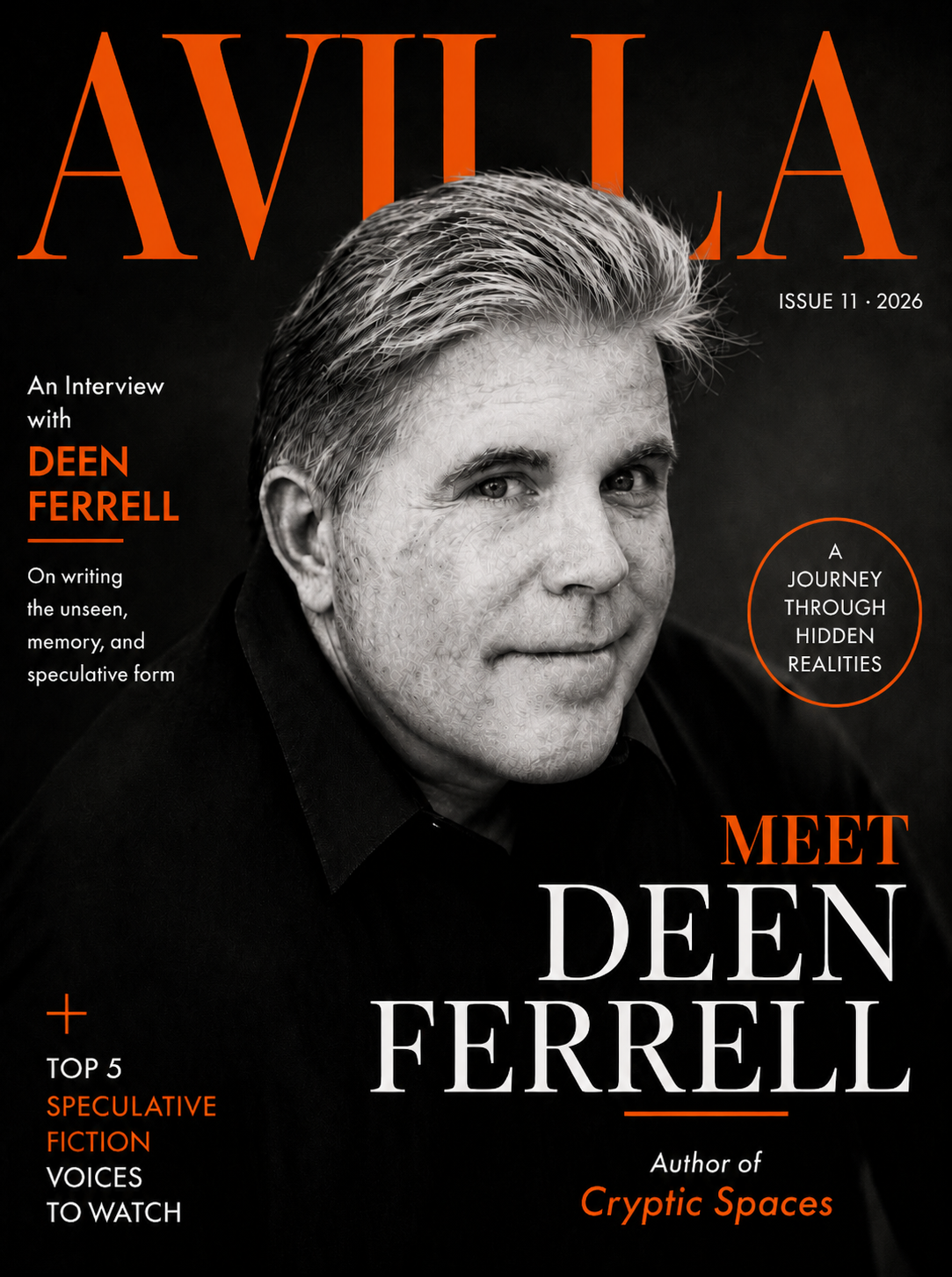
Introducing…
Deen Ferrell is the author of the Cryptic Spaces series, a collection that showcases his flair for suspenseful storytelling, speculative fiction, and immersive world-building. With all five books now completed and available across multiple online platforms and major booksellers. Ferrell continues to grow a readership drawn to his blend of mystery, adventure, and imaginative fiction. Beyond his books, he engages with readers through his official website and YouTube channel. In this interview, we explore the creative journey behind the Cryptic Spaces series, his inspirations, and the storytelling vision that shaped all five books.
What compels you to write, beyond habit or profession?
The singer-songwriter Neil Diamond speaks of a level of being that is “like a page that aches for a word, which speaks on a theme that is timeless” (Jonathan Livingston Seagull). For me, my level of being is tied to a hand that aches for a pen that seeks those grand thoughts that are timeless. I write because I must. I write because I have things I must say. I write because I know if I say things in just the right way, laying down just the right words, in just the right order, I can give life to a page, and it will continue to speak long after I am gone. I write because I love hearing the vast cacophony of diversity sparked when one heart speaks and others truly listen. I write because I do not wish to face the shadows of infinity alone.
Where does your work locate truth—in language, memory, or imagination?
There is a quip attributed to Winston Churchill that goes something like this: “Men often stumble over truth, but most pick themselves up, brush themselves off, and hurry on as if nothing ever happened.” I believe truth is constant. It is in our quest for it that we writers get mired in the muck of proverbial sandboxes. Sometimes, I do catch a glimpse of it in the words I hear a person or a character speak. Sometimes, it proceeds as a rumble of thundering memory–a bright crack of recognition etching light across the dark corners of my mind. Most frequently for me, however, it is recognized within constructs of my imagination, where social mores relinquish their hold and time slows to a gentle dance. Here, obstacles can be systematically weighed and balanced before some imposed sense of immediacy forces a fight or flight response. Truth, I believe, must be coaxed. It can never be forced, which is precisely why it is so hard to find. If we merely seek to understand it in hindsight or try to capture it within walls of written words, it too often, I believe, skitters away and becomes lost beyond our reach.
How do you negotiate silence and voice on the page?
What is silence in written word? Or, perhaps, better still, what is the connection between silence and voice? I recall a conversation I had with an older gentleman in Scotland once. He had a habit of speaking to his car as he drove. I asked him why he did this. He chuckled, then answered; “Aye, well, I drove a cart for many a year, and bless me, I always spoke to me horse to thank he for getting’ me home safe. This here contraption gets me home just so—so why wouldn’t I thank he for the same?” I thought it was a good question. Is it possible that everything, even silence, has a voice if we are willing to listen, to be still and learn to hear? I have come to believe that silence must be my first focus in my work. Silence is the underpinning from which voice takes courage and learns to speak. It dictates tone, direction, and intensity of voice. It is in silence that voice learns what, how, and when to make itself heard. It is in silence that voice comes to truly understand what it has to say. I negotiate voice on the page by carefully listening to and for the guidance of silence.
What resists articulation most in your writing?
I had a friend in college who was a talented artist. One day, I was admiring his work on a portrait, and I asked him: “What was the biggest challenge for you in drawing this face?” He answered, without hesitation, “the nose.” He went on to explain; “The nose can’t be drawn by a single line. It’s the result of line upon line, creating shading, creating shadow, and of paying the utmost attention to pigment and tone.” In a similar way, I’ve found that articulating emotion in a scene cannot be done with a single line. If you want a character to come alive in a story, there must be a fair amount of shading–undertone, nuance, and personality—woven subtly into the structural build of the story. Otherwise, there is insufficient background to effectively support moments of high emotion. In short, it’s tough to get it right. I learned to plan for multiple rewrites based on feedback from a variety of readers and on input from other writers. I also spend time traveling and applying a keen sense of observation to interactions between others, especially emotionally charged interactions. These processes and tools have helped me create and capture more emotionally rich characters. As writers, we may sometimes hear “that’s not my experience.” But that’s the very point. Good characters ring true to themselves, not to some idealized notion of who they should be.
Is style a deliberate construction or an emergent instinct?
My writing style grew out of my writing journey. I have never stopped to deliberate on creating a style, but I have been told time and again that my writing is distinctive. Ray Bradbury claimed he came to style by regarding it as personal truth. He advocated speed in writing to safeguard one from over thinking. Dickens wrote dense, serialized prose designed to create high engagement through frequent cliffhangers, a style that perfectly supported his flamboyant read-aloud appearances. There is a bit of both men in my heart and likely in my writing, but more besides. I find this world a fascinating, amazing place, one filled with wonder and pain, sunshine and heartbreak. I strive for a sanguine disposition, finding the beauty of life far more interesting and worthy of note than the tepid fashions of human devolvement. I suspect I am unique as a person; therefore, my writing is unique.
How does time whether personally or historically, shape your narratives?
That’s an interesting question. How does time shape any of us? I guess that depends on how we define time. Is it the hourglass that ticks away the beats of a heart? Is it a way to organize our universe such that we can compare, contrast, and learn from our heavens and our homes? I see time as our opportunity to learn to become, to reach a higher level of being. What and how we become is often at the heart of what I choose to write.
What does your work refuse to resolve?
The great film director, Akira Kurosawa, was once being hounded by a group of reporters who wanted him to go into detail about the symbolism in one of his films. He responded by referencing an old Chinese proverb called, “Drawing Legs on a Snake.” In the proverb, a landowner decides to share a cask of his best wine with his three servants. The servants decide to have a contest to see who gets the wine. They decide that each will draw a picture of a snake, and the first to finish wins. The contest begins, and in no time, the first servant, an accomplished artist, is done. He finds the other two lagging far behind, so he decides, while he has extra time, to further impress his fellow servants by drawing legs on his snake. The second servant becomes distracted, arguing that snakes do not have legs. This allows the third servant to finish his snake and win the prize. The point Akira was making was that sometime too much information can ruin what is already sound and good. It’s the same in writing. The unresolved keeps us coming back to a story. So long as what is resolved provides an adequate release, the unresolved allows the mind to become a partner in creation, probing the work for clues, and creating for an individual its most satisfying long-term end. My work typically focuses on the resolution of a benchmark but does not resolve the full equation of a character’s extensive life or legacy.
Do you write toward clarity or toward complexity?
Clarity is what complexity wants to be when it grows up. Do I write complex stories that have a lot of moving parts? Absolutely. Are there concepts in my books that infuse high level science, math, and physics with art, music, and sports? Absolutely. Do I apologize for asking my readers to think while taking them on a fun ride, fueled by mystery, humor, romance and adventure? Absolutely not. Clarity comes when a story is true to itself.
How does absence function in your texts?
Absence has always been a key element in the hero arc. It forces the protagonist to pull answers from his or her self and find the strengths needed to face seemingly unconquerable risks. The Chinese glyph for “risk” includes idioms for both “opportunity” and “challenge.” The characters in Cryptic Spaces are forced to sacrifice time with their friends and families to stop the world they know from disappearing, but they find in this absence both opportunity and challenge. They must learn to face themselves, their own internal doubts and foibles, in an arena where they have little to gain and everything to lose. But, if they succeed, they will come to understand who they really are and what they can truly become. Absence, in my texts, deals with more than just separation from the known and familiar. It is a clear catalyst for character growth and a rugged path for each character to find, leading to ultimate maturity should they choose to follow.
What ethical responsibility does a writer carry, if any?
I believe we have ethical responsibilities as human beings to safeguard the beauty and wonder of our world, to strive to increase tolerance, encourage kindness, and support personal growth through mutual empathy and respect. I believe I have an ethical responsibility as an author to be true to myself in what I choose to write and propose.
How do you approach the limits of language?
It is certainly true that some emotions and high intensity action are hard to explore in word alone, but to my mind, that’s the beauty of it! One man’s limit is another man’s opportunity. We have already expanded the reach of Cryptic Spaces into the music realm. We currently have two songs streaming; “Just Another Lonely Kid Like Me,” with music and vocals by Jazz vocalist Leah Finkelstein, and “Never Really Was,” sung by Heather Stewart. We are now looking to expand into graphic novels and film adaptations. The book series has been called “cinematic,” and described by some reviewers as “most likely to become a miniseries or new film franchise.” This isn’t surprising to me. I write while watching a full media extravaganza play out in my mind, complete with soundtrack and special effects. But I do love the written word. It is what locks my raucous stories down, allowing them to be judged and enjoyed. I don’t find language limiting. I view it as a grand catapult, allowing me to share, contemplate, discuss, and collaborate with a wide diversity of like-minded souls. I view the written text as a keeper of secrets, a promise that no song, no graphics, no film will ever fully capture or captivate as a good story does, forever sharing its bright nuances across the dim annuals of time and space.
Is your writing more concerned with interiority or the external world?
When people look in the mirror to comb their hair, is it due to an internal or an external need? In short, I don’t see the two as either/or. The internal world of a character is undeniably connected to the external behavior he or she exhibits. Do I focus more on the internal or the external? I focus on what’s needed at that point in the story. I see the two as different but necessary sides of a single coin.
What role does contradiction play in your work?
I have found in life that what seems contradictory is often not. The comedian Jerry Seinfeld does a hilarious sketch about seeming contradictions. He points out that kids live in a world where everything they want is up. Wake up! Hold up! Shut up! I want to get up! Parents, on the other hand, live in a world where everything they want is down. Slow down! Sit down! Calm down! Just let me lie down! The fact that parents are up and want down, and kids are down and want up, seems like one of human nature’s funny little contradictions. But is it? Some of us who have been through both of those stages in life may argue that these seeming contradictions are not contradictory at all. Children have an overabundance of energy and seek rapid growth, so, of course, they are focused up. Adults, burning the candle on both ends to cope, need time to take their heavy loads off the shoulders for a moment and just want to sink down. I love the humanizing element contradictions like this have on the context of a story. By allowing us to see ourselves in seeming contradictions, the story becomes more relatable and the reader bonds more closely with the obliging character.
How do you recognize when a piece is finished?
When the characters say, “amen.” That may sound funny, but I write by following my characters and trying to keep up while they take me through the action and nuance of the story. I may have some vague concept in my head as to where the story will end, but it is rarely even close. Typically, I’m about as surprised as anyone when the protagonist and his entourage drop their last line, but I do clearly hear that audible ping in my mind stating, “Okay, guys, wrap it up! We’re done here.”
What question does your writing keep asking even when unanswered?
What am I not seeing in the world around me? Is adventure a dream to long for, or an experience we find to be woefully beyond our pay grade when the real thing comes along? Is the complexity of love forever beyond the reach of finite understanding?
From my unwritten work, I hear rumbles of; What’s next? I have more characters and stories rattling around in my head than I will ever be able to write in my lifetime. So, unfortunately, I must pick and choose. The problem is that some of my unknown characters are not very happy with my choices…
Suggest five tips that can help writers hone their crafts and become better.
Tip One: Observe, observe, observe. Look beyond just the surface things. Find the secret worlds that lie all around you, just out of sight.
Tip Two: Write. Don’t wait for inspiration. Look around. Pick an item. Ask yourself; What if this were the focus of a story? What would that story be? Then start writing and don’t stop for at least 20 minutes. After you stop, don’t read over what you wrote. Just pick another item and do the same thing. When you’re done with your third item, take time to read through all three of them. Is there anything worth keeping? Any story germs that are tickling in the back of your mind? Keep doing this exercise until something sticks and it won’t go away.
Tip Three: Learn to trust yourself. Listen to others for advice and perspective, but don’t let them rattle you. Take bad reviews, read them once, then burn them, or rip them up. I find I learn little from horrid reviews with no positive observations for balance. From kinder, but not glowing reviews, I ask myself candidly; Is there something I can learn from what they have to say? But most importantly, I have learned to listen to myself. Did I say what I wanted to say? If you don’t learn to trust and listen to yourself, how can you be sure that you carry clarity in your voice that you are staying true to you?
Tip Four: Write from your heart, not your wallet. People will tell you, “This is hot,” or “That is trending!” but a real author isn’t made that way. A real author sets trends. He or she is not built to blindly follow.
Tip Five: Take something you wrote that you are proud of, that you feel passion for. Imagine in your mind what it will feel like to finish a more complete manuscript that you feel the same about. Keep that image in your mind and never let it go. The painter, Whistler, had a rose he painted and kept over his fireplace. A friend tried to buy it once when he was in financial trouble, but he would not sell. “Why?” the friend asked. Whistler turned to him. “Sometimes, you see, Whistler starts to believe he can’t paint, that he’s wasting his time, that he’s dragging everyone he loves down. At those times, he forces himself to come here, to stand before this fireplace and look up at that painting. Then he tells himself; You can paint! Look at that picture! And he turns himself around and gets back to work.” Keep your ‘rose’ close and clearly in your mind. View it often.
Deen’s books can be purchased on Amazon and at www.deenferrell.com