
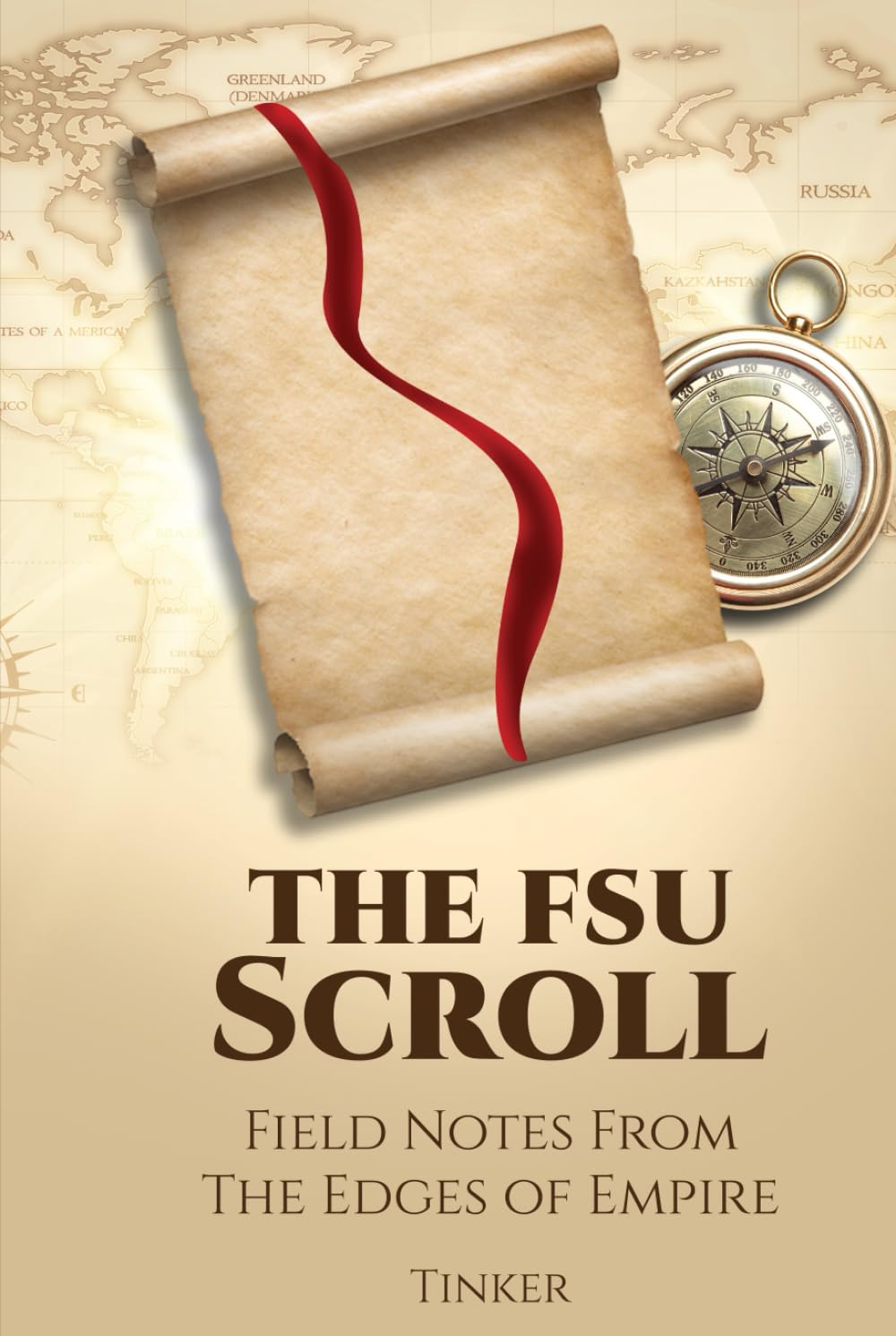
A Review by Gina Cockney
“We arrived in tailored optimism.”
Five words. No wasted syllable. With that single sentence, the author of The FSU Scroll: Field Notes from the Edges of Empire announces something far larger than a physical arrival. He announces a condition: the peculiar and enduring delusion of the Western-trained professional who steps off a plane into an unfamiliar world believing that competence travels well, that a good suit is a universal passport, and that a briefcase stacked with contracts constitutes leverage in a system whose rules were composed in a language nobody offered to translate.
What follows across the book’s ledger-structured pages is one of the most genuinely original works of literary nonfiction to emerge from the post-Soviet business frontier. It is a memoir, a satire, a field manual, and, in its finest passages, a work of quietly serious moral philosophy about what it means to survive, and sometimes to flourish, inside institutions designed to confuse, exhaust, and ultimately absorb every outsider they encounter. In an age of earnest self-discovery narratives and management parables dressed as memoir, a book this alert to its own purposes is a rare and necessary thing.
The Suit and the Slop
The book’s opening ledger, FSU First Entries, subtitled with characteristic precision “Shoes, signals, and the anatomy of expat arrival,” establishes its thematic architecture within the first few pages. The narrator and his colleague BOK disembark, suited and scarved, armed with Montblanc pens in a hand-stitched roll, into Ukrainian slop. Their Italian leather shoes absorbed three continents’ worth of confidence and three hundred millilitres of Ukrainian slop in thirty paces. A heel is surrendered to a frost-heave ridge. Wool socks must be borrowed from the camp cook and are never returned.
On the surface, this is elegant comedy: the colonial dream of the Western businessman undone almost immediately by mud. But the passage is doing something more precise. The shoes are not simply impractical; they are ideological objects. They represent an entire theory of the world, the assumption that signals of authority functioning in London or New York will carry equal weight on the mudwashed gravel of a half-decommissioned Soviet base. The mud is not merely mud. It is the landscape’s refusal to participate in the terms being offered.
Vasily, the grinning interpreter assigned to receive them, looks the arrivals up and down and offers two words: “Right. First-timers.” An entire course of study compressed into a glance. Then, arriving in camouflage and proceeding to laugh until he nearly chokes on his cigarette, comes a Soviet-era geologist who rasps: “Businessmen. Always dressed to die.” He is not being cruel. He is being diagnostic. He has survived things the narrator cannot yet imagine, and his amusement belongs to someone who has watched this particular performance before and already knows how it resolves.
What follows, in the entry titled “Retreat from Form,” is one of the book’s most quietly brilliant sequences. The suits retreated piece by piece. Ties were the first to go. Then jackets. By day three, the Canadian contingent had swapped collars for flannel and tactical synthetics. Scarves vanished into camp laundry or were bartered for cigarettes. The Hermès scarf was reclassified as a pipe wrap. The Montblanc pen roll disappeared entirely, likely repurposed by the welding crew for holding O-rings. “We arrived dressed for a summit,” the narrator writes. “We stayed dressed for a siege.” The locals, who had been dressed for the siege since birth, barely noticed.
An engineer from Dnipro wore the same quilted vest every day of the year, summer or winter. He swore the lining had been made from East German tank insulation. Whether or not this was true, he was the only one warm. The observation is delivered without commentary or moral instruction. The reader feels it land.
The Grammar of Confusion
Ledger 2, Enter the Durak, subtitled “Trust, translation, and tactical underestimation,” elevates the book into a work of genuine cultural intelligence. What the ledger offers, beneath its comedy, is one of the most acute accounts of negotiation across radical cultural difference that this reviewer has encountered in literary nonfiction.
The opening entry, “First Contact,” proceeds as follows. The narrator’s team enters a joint-venture boardroom with a lawyer, a translator, and what they believe to be a bulletproof contract. Their counterparts arrive with tea, pickles, and five people whose job titles have no equivalents in any Western organisational chart. Both sides nod. The translator translates. Both sides nod again. Agreement appears to have been reached. It has not.
What has actually occurred is that two entirely different grammars of reality have been performed simultaneously in the same room, with neither side acknowledging the incompatibility. The narrator’s team has been conducting a contract negotiation. Their counterparts have been conducting a relationship assessment. These are not the same activity, even when they superficially resemble each other. When the translator later reveals what was actually said, that the counterparts believed these people don’t know what they’re giving up but let’s play this out, it is not a revelation of bad faith. It is a revelation of structural difference. Two systems of commerce, built on entirely different assumptions about what meetings are for, have briefly occupied the same room and failed to parse each other.
What makes the author’s handling of this scene remarkable is the complete absence of indignation. He does not cast the counterparts as villains or as objects of anthropological curiosity. He casts both parties as prisoners of their own epistemic frameworks, people doing exactly what their training prepared them to do in a situation where that training is simply the wrong tool. “We didn’t revise the contract. But we revised our assumptions.” This is the book’s ethical position in miniature: adaptation, not accusation; curiosity, not grievance.
The phrase “Tee Nachalnik, Ya Durak” (You are the boss; I am the fool) becomes the book’s most enduring analytical object. Used sparingly, it allows the counterpart to feel superior. Used wisely, it allows the narrator to identify the actual authority in any room. The moment he speaks the phrase to a mid-tier manager while glancing at the man beside him, and that second man immediately barks an order and ends the meeting, is one of the book’s finest scenes. What began as a defensive instrument has become a sociological probe, a sounding device lowered into murky institutional waters to locate the hidden topography of power. That the phrase is eventually quoted back to the narrator, becoming in his words “mutual camouflage,” is one of the book’s most satisfying moments. Both parties have adopted the same ritual irony. Something has genuinely shifted; not trust exactly, but a species of mutual recognition that functions in trust’s place.
The interpreter known simply as L illuminates all of this further. She is the book’s most remarkable supporting character. Where others translated words, L translated tone, a far more demanding and consequential skill. In a heated debate about drilling rights, she pauses, turns to the narrator’s team, and quietly relays: “He says you are competent… but naïve. And he is willing to help fix that.” What he had actually said was unprintable. She had not mistranslated; she had upgraded the exchange, converting a confrontation into an opening. She saved the meeting. She was given a raise. Eventually, because both sides kept attempting to hire her away, they simply doubled her pay and called her “our other lawyer.” The episode, told in under a page, contains more insight into skilled diplomacy than most books dedicated entirely to the subject.
The Road That Was a Promise
Ledger 3, Tracks, Tanks and Teacups, subtitled “Winter improvisation, mechanized miracles, and the machinery of survival,” introduces the landscape as a kind of antagonist, though one entirely without malice. The routes to the work sites, the narrator explains, did not begin as roads. They began as lines on Soviet military maps that said “Road.” In summer, these were swamps. In winter, they were promises.
“We didn’t start with roads. We started with snow.”
Tracked vehicles were summoned. Skidoos prepared. A grader was coaxed back to operation with vodka and mechanical optimism. Fifteen kilometres in, the convoy lost visual reference entirely. The only guide remaining was the treeline and one local driver’s sense of smell. He got them through. He was promoted to Director of Navigation (Non-instrumental).
The overnight train connecting base to field is the subject of “The Train Ride from Hell,” an entry that reads like a compressed novella of Soviet infrastructure in its terminal phase. The train, which appeared not to have moved since the Red Army last retreated, was half troop transport and half haunted house. Sixteen hours. Wood seats. A toilet that was a hole in the floor with a view of frozen rails below. Heat that was patchy at best. Every trip was a gamble: would the brakes freeze, would the stove go out, would they arrive at all? One winter the train stopped in the middle of nowhere for seven hours. The passengers played cards with two welders and a geologist, made stew from sausage and instant noodles cooked on a blowtorch, and by the time they reached camp had developed a plan for rail improvements, morale programs, and a new recipe named after the geologist. They never used the plan. The stew caught on.
It is impossible to read passages like this without thinking of the great literature of human endurance in extreme conditions, not in the heroic mode of polar exploration, but in the quieter, funnier, and arguably more accurate mode of people simply getting on with it. The book belongs to a tradition that includes Gerald Durrell’s comic naturalism and Kapuściński’s sociological eye: writers who understand that the most revealing moments of human character occur not in crisis, but in the long grinding interval between crises, when adaptation becomes routine and improvisation becomes culture.
The Scud Crane Solution is perhaps the book’s single most audacious anecdote. A hundred-ton crane was required to lift a compressor package at the site, and none could be found locally: too small, too broken, too fictional. Someone suggested the old military yards. There it was: a hundred-ton crane mounted on a Scud missile launcher chassis. Soviet dual-use doctrine at its finest. After half a day of coaxing and a barrel of diesel that smelled like regret, it roared to life. They drove it slowly and gloriously to the site. At every checkpoint, soldiers stared. One asked if they were planning to invade. “No. We’re just here to lift heavy things.” He was waved through. They used the crane twice. Then it was parked beside the tea hut, where it became a landmark. “Go left at the missile crane. Everyone knew where that was.”
The Theology of Duct Tape
Ledger 5, The Language of Duct Tape, subtitled “Holding it all together, one improvised miracle at a time,” is, in this reviewer’s estimation, the philosophical centrepiece of the entire book, even as it presents itself as straightforward comedy. The joint venture operated in four working languages: English, Russian, Ukrainian, and Oilfield Profanity. But the real lingua franca was duct tape.
On its face, this is a good joke. On reflection, it is a serious claim about the nature of knowledge in conditions of scarcity and institutional dysfunction. Duct tape does not merely hold things together mechanically. It is the material embodiment of a particular cognitive style, one that prizes adaptability over rigidity, practical intelligence over theoretical correctness, and the capacity to make something work over the insistence that it should work according to its specifications.
The episode of the German-built generator is the book’s most resonant comic set-piece. Theoretically durable and well-engineered, the generator hated the cold and refused to start below minus fifteen degrees. This was, as the narrator observes with perfect deadpan, problematic, since it lived at minus twenty-five. Every conventional intervention was attempted: heaters, blankets, three languages of cursing, sacrifices of old fuses. Nothing worked. Then Sergey, the mechanic with frostbite in his beard, wrapped the intake with duct tape, lined the fuel hose with foil from a chocolate bar, and lit a candle under the starter housing. The generator roared to life. They named it The Sinner’s Choir. It eventually became more tape than generator. It never missed another start.
The comedy is impeccable: German engineering defeated by Russian ingenuity; a precision instrument saved by a chocolate bar wrapper. But the philosophical resonance is what distinguishes the episode from mere anecdote. Sergey does not fix the generator according to any manual. He fixes it according to an understanding of thermodynamics, combustion physics, and available materials accumulated through years of making broken things function in broken environments. This is what anthropologist Tim Ingold calls “wayfaring knowledge,” understanding that is not abstract and portable but embodied, relational, and inseparable from the encounter between a skilled practitioner and a specific material reality. Sergey’s knowledge cannot be written into a maintenance protocol or imported along with the equipment. It can only be grown, over years, in exactly this kind of cold.
Ledger 5’s most conceptually daring entry, “Duct Tape and Honour,” articulates what the rest of the ledger only enacts. “There’s an odd thing about improvisation under pressure: it creates a code.” In the mess hall there was a spiral-bound notebook labelled “Field Fixes.” Each page contained a sketch, a few lines of explanation, and a rating system: one star for something that might work once; two stars for reliable enough for the afternoon; three stars for what the notebook described as “Tell No One, Use Always.” Engineers hated the book. Operators revered it. By the end of year one, it was laminated and chained to the table.
A welder with a cracked helmet visor had patched it with a duct-taped rectangle cut from an old plastic report cover. Every time he flipped it down, it made a sad little fwap. But it blocked the arc. When offered a new one, he declined. “That coat got me through a night in the boreal line.” They stopped offering. The patch was not a deficiency. It was a credential.
The Beard as Document
Ledger 7, The Border and the Beard, brings the book’s meditation on performance, identity, and institutional power to its most overtly comic expression. A clean-shaven expatriate is held at a border post for six hours while his passport is scanned, re-scanned, misfiled, translated into three Cyrillic alphabets, and lost entirely. He is eventually released when someone recognises him from lunch two weeks prior. Two days later, the same man returns to the same crossing: unshaven, wearing a shapka, mumbling in broken Russian, and chewing sunflower seeds. He is waved through with a salute.
This is funny. It is also a precise account of how identity operates within bureaucratic systems. The border official is not reading a face; he is reading a performance of belonging. The professional bearing, the Western passport, the careful grooming are legible, in the semiotics of the checkpoint, as otherness, as an administrative problem requiring management. The beard, the shapka, the sunflower seeds are legible as similarity, as someone who obviously belongs to the landscape and therefore generates no friction. The documentation has not changed. The performance has. And in an institution that processes people through pattern recognition rather than genuine identification, the performance is the identity.
The author codifies this with mock-bureaucratic precision, “Article 7: Facial Hair and Other Forms of Soft Power,” added to the field manual, and in doing so achieves what the best satirists always achieve: a joke that is simultaneously a diagnosis. The Vehicle Diplomacy entry extends this analysis into the material domain. A foreign-registered Toyota signals espionage or an NGO, both bad. A pristine Land Cruiser suggests resource wealth that attracts envy or exploitation. But a battered Soviet Niva with foggy headlights and zip-tied mirrors is invisible precisely because it performs belonging. The engineer who paints a Soviet ambulance in JV white, fits it with a siren that no longer works, and stocks it with supplies has not obtained permission. He has manufactured the appearance of permission. In a bureaucratic system that cannot always distinguish between the two, the appearance is sufficient. This is applied institutional literacy: the understanding that in contexts where formal permission is unavailable, a credible performance of it is the operative currency.
Why This Book Matters
The early 1990s witnessed one of the most dramatic episodes in modern economic history: the simultaneous collapse of the Soviet command economy and the attempted transplantation of Western market capitalism across an enormous geographic space organised, for seventy years, on entirely different principles. Western advisors and businesspeople arrived carrying economic models designed for environments with functioning legal systems and reliable property rights. They found environments where contracts were aspirational documents and institutions were either being improvised or looted, frequently both simultaneously.
The literature that emerged from this encounter is, with notable exceptions, thin. Most accounts are either triumphalist, stories of bold Westerners bringing civilisation to a benighted system, or indignant, exposés of corruption and squandered opportunity. Very few have held both the absurdity and the genuine human texture of the encounter in the same frame, without condescension toward either party, with formal sophistication that makes the material feel like art rather than testimony.
Scrolls belongs to a small company of exceptions. Like Kapuściński’s work in Africa and the Middle East, it finds in the encounter between systems a lens through which to examine universal operations of power, adaptation, and human resourcefulness. The book’s subtitle carries deliberate ambiguity. Field Notes from the Edges of Empire refers immediately to the former Soviet empire whose institutional residue the narrator navigates daily. But it also gestures toward something less comfortable: the imperial logic of Western commercial expansion itself, the confident assumption that where capital travels, progress follows. The narrator is too honest and too intelligent to be fully comfortable within that logic, even as he is embedded within it professionally. His field notes are, in part, a record of its limits.
The narrator’s central discovery, enacted across ledger after ledger from the borrowed wool sock to The Sinner’s Choir to the missile crane parked beside the tea hut, is that the world’s refusal to conform to expectation is not a failure of the world. It is an invitation to look more carefully, adapt more flexibly, laugh more readily at oneself, and understand more deeply that the improvisations demanded by impossible conditions are not departures from human dignity but expressions of it. The Scud crane lifts the compressor. The duct tape holds the generator. The beard gets you through the checkpoint. The fool identifies the boss.
From the Scrolls of a Modern-Day Tinker is a polished, witty, and formally intelligent work of literary nonfiction. It is distinctive in voice, rigorous in observation, and genuinely pleasurable to read. A voice this specific, this knowing, and underneath all of that this humanely serious is scarce in contemporary publishing. It is the kind of voice that creates not merely readers but advocates: people who press the book on colleagues and strangers, certain that this is precisely what the other person needs to read.
The ledger, like all good ledgers, remains open. There are entries still to be written.